
News — Norfolk artist
New Series - Breathing Space
The gaps engineer breathing spaces in the painting that encourage an additional dialogue within and around the work. Whilst the three-dimensional planes of the plates engender an alternative viewpoint, the ceramic forms deliver shadows and highlights creating intriguing faceted elements that change with the light. Embracing the Japanese concept of Ma, where each negative space is as valuable as the positive, each void adds meaning, balance and rhythm to the painting.

The concept for the painting is developed and then the lengthy process of sourcing the exact combination of antique ceramics to build the platescape is commenced. It is not only the shape and size that matters, but also the clay, the age, wear and marks. Decoration, colour and subject are also key, as all contribute to the success of the composition. Each element is well researched before the final painting is planned.

The language of the old cloth is harnessed to enhance the pictorial narrative. By using the characteristics of antique material as a canvas, it becomes a contributing value to the work. The ancient hand woven cloth, with its attractive vagaries of the hand made process, is extolled in each celebration of the selvedge, hem, join or seam. Antique embroidery, cutwork and lace are employed in some paintings, where this extra attribute is appropriate and prized.

The pattern on the original plates is fundamental to the concept behind the work. Whether traditional bucolic scenes in Toile de Jouy style or massed florals, the aim is to guide the subject matter and enhance the final composition. From a distance the overall effect is harmonious, but on close inspection the miniature details are revealed. The manipulation of scale adds further depth to the engagement.


Creating art with a multi-layered ambition has always been a preoccupation. In 'Breathing Space' I have found a challenging format that embraces my passion for both painting and form. The platescapes add a 3D perspective that bridges the gap between painting and sculpture.
Blue Vase
An original still life oil painting on a collection of 7 pieces of antique china. The painting features preserved eucalyptus leaves and dried craspedia flowers in a blue vase with an orange and lemon, becomes disjointed and yet enhanced, as the narrative is rewritten in the breathing spaces.

Materials:
Ceramics
7 pieces of antique crockery
- Pair of antique Booths tureen plates in the Princess pattern. Semi porcelain Rd. 183173.
- Victorian tureen plate no.186329
- Antique tureen semi-porcelain plate no.345664
- Booths 1906 moon side plate in Lowestoft Border design
- 1886 saucer Pre Shelley Old Foley Rd. no. 49676 (3645)
- Victorian Childs doll house plate with willow pattern
Cloth
Old linen tea cloth - hem used to suggest a frame
Paints
Michael Harding UK: professional hand made, ethical oil paints.
Hanging
Each part of the painting is supplied with a plate hanger.
A life size plan, showing the exact location for hanging each composite piece, is provided.

Dimensions of composite painting: height 63cm x width 56cm

Fishing
An original oil painting on a collection of 4 pieces of vintage china. The painting features freshwater fish swimming in a golden pool of light where the breathing spaces add another layer of disjuncture. The narrative is enhanced with the bucolic scenes of fishermen on the vintage plates.
This artwork was launched at The Gallery, 23 Lees Yard, Holt NR25 6HS in the Fired Earth exhibition 31st October – 10th November 2026.

Materials:
Ceramics
4 pieces of vintage crockery
- 1930-40 Royal Doulton 'Norfolk' dinner plate
- 1950-60 Crown Ducal 'Bridge Scenes' dinner plate
- Vintage Alfred Meakin 'Queens Castle' oval serving platter
- Vintage dinner plate
Cloth
1800s French peasant flax cloth - grown, spun and hand woven by rural folk - hand stitched hem used to suggest a frame
Paints
Michael Harding UK: professional hand made, ethical oil paints.

Hanging
Each part of the painting is supplied with a plate hanger. A life size plan, showing the exact location for hanging each composite piece, is provided.

Dimensions of composite painting: height 71cm x width 61cm
Failing and Learning

One of the delights of painting with oils is the meandering journey that lets you experiment and fail. The small wins are precious and deliver joy. I have always had a buzz from learning, so painting feeds that in a quiet, understated way that keeps me curious. It's not just the activity that is so absorbing, it transports you to another world, it is also the thinking. The thinking requires not just a collective memory bank of skills, but an enquiring mind and willingness to take risks - what if I...? It is a constant problem solving exercise and the search for resolutions can be taxing. Even after all these years, there are conversations in my head about risk taking and rising to the challenge, underpinned by the "You CAN do this" mantra.


And what happens when the result is not even satisfactory? The task of 'making it right' can form a loop that becomes a bottomless rabbit hole of intense pushing. One is often unaware that this is taking over. Step away, give both time and distance to the issue. Then refreshed, this could be hours or weeks later, judge it anew and matters have often shifted. Now that troublesome area is actually quite good, whilst the bit that you were pleased with before is alarmingly wrong!


With oils, time is your friend. I have painted with all the different media over the years - experimenting, playing and analysing each material and technique for its foibles. Each media has its own attractions and limits and finding one that connects is key to building a deep relationship. I first tried oil painting at an evening class I attended aged 19 - I timidly brushed the paint with little strokes from a little brush. At art college, oils were never discussed, whilst the more instantaneous acrylic paint was favoured. I returned to oils years later as my fascination with building texture and form on a 2D plane became a focus. A palette knife and thick oil paint now provide endless possibilities and happiness. But with oils, time is also not your friend if you are impatient. Impasto painting demands lengthy drying times which can be frustrating when the next layer of engagement is beckoning. I have learnt many times that muddiness awaits if you revisit a wet painting too soon. All that squishiness is delicious, but be aware of the trap of impatience.
 .
 .
Letting go is one of the hardest things. A painting that just isn't working, but has delightful elements is a conundrum. Should I continue or just start again? When to push through and when to move on, is still a dilemma. It is at this point I ask myself "What is the value of continuing?" Obviously, the answer should inform the decision, but often there is a niggle remaining. Is that the vagaries of the creative brain or something else? Ultimately, deciding is a choice only you can make. I have found that what one may consider helpful opinions from others, usually are most unhelpful. Yes others views have value, but its the artist that must exercise omnipotence over their work. After all, a painting is an artist's statement of self expression.


The Agony and the Ecstasy of Oil Painting
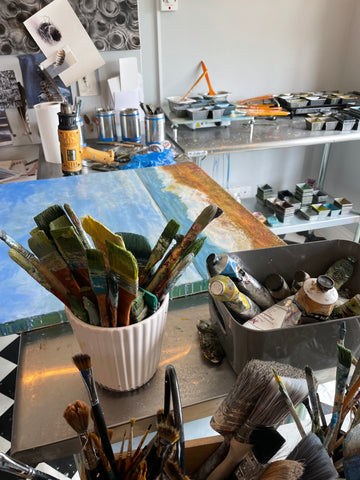
The Agony and the Ecstasy of Oil Painting
Jac Scott
A friend recently asked me if I ever get bored painting the coast? My reply came easily - the coastline is always changing, in every second it metamorphoses. Aiming and failing to capture that energy or tranquility is so bewitching that I'll never master it or tire of trying to do so.
Painting the Norfolk Coast
The elements of sky, sea and shore dance and shift continually. It's the movement and the interplay of the elements that is beguiling. Standing before the ocean and absorbing the sights, sounds and smells to carry home to the studio, is both humbling and invigorating. I find making short videos of the panorama can help the journey, but nothing matches the initial excitement of the moment. Doing quick sketches and colour studies are an intrinsic part of the process. The large scale I prefer to work at demands a big set up, so it is highly problematic working on location.

Painting Simple Compositions with Complicated Layers
The compositions are rudimentary - I really like that. Capturing the viewer's eye without an obvious focal point demands other elements of interest and nuance. Colour and texture are key. The process is dynamic. It makes it even more challenging to carry that simplicity and create a picture that has depth, movement and spirit. The techniques I use embraces this - nurturing the notion of shifting layers. Visualising and then building the layers is a multi-pronged operation where understanding three-dimensions is critical. One is building from the back of the painting and seeing forward - therefore planning is key.
Each element is faceted like colours - their translucency or opaqueness is important to exploit the medium's variables. Subject matter such as skies and seas envelop the multi-layered approach and react well to embracing different strengths of coloured layers.

Emotional Painting
Yes the paintings are emotional expressions, not copies of anything stagnant. I want them to be transitional - to carry one to another place - to form a ticket to ride. Painting requires concentration and control, and yet however much you master the materials, there is always an element of serendipity that I love. That unexpected joy or horror that emerges when you think it's safe. This duality of agony and ecstasy whilst painting becomes a canvas full of problems to solve and I am elated if I manage to master them. Such an absorbing activity is demanding both mentally and physically, especially when I work on the big panels. The width and longevity of my art practice definitely informs my painting. It has nuances towards sculpture - planning in three dimensions, layering and cutting back.

Moving to North Norfolk
I grew up by the sea and regularly spent hours watching the waves, never thinking that those early memories would guide my focus now. When we moved from Bournemouth to the Lake District I was still needing to regularly visit the coast and share the big skies away from the brooding mountains. Moving to North Norfolk was liberating - it is a special place: a sanctuary and a stimulus for my spirit and my art practice. We had visited for seven years before we decided to move permanently - it was the best thing we ever did.


Red Lace - a story of a painting

A simple story of a painting.
Sometimes it’s the simple pleasures of living in this beautiful county that bring a lingering smile, such as looking forward to the casual, yet dynamic blooming of the wild poppies in June. The impact can be just a single lost flower or the invasion of a whole field swathed in red.

But usually it’s a graceful lacing of the field edges - red heads of delicate crepe paper petals bobbing in the breeze.

This June on a winding lane from Edgefield, near Holt, there was a particularly wonderful field of poppies - so inspiring I had to paint the view.


Launch of 'Linear Lands' Original Oil Paintings Collection
2020 saw the start of a whole new portfolio of paintings for artist Jac Scott. Fluid Lands emerged through the lockdown as the artist was able to dedicate significant studio time to developing the new work with pigments and wax. The Storm Collection was the initial response now followed by Linear Lands.
Each work is a unique response to local Norfolk sea and land scapes.
Inspiration - Linear Lands Collection
North Norfolk, with its big skies and undulating vistas, specialises in creating layered wide and sinuous bands of landscape.
There is a rhythmic poetry where the bands of interest stretch across the land forming stripes of colour, texture and form. This striping delineates and dissects the panorama leading to an inspiration that explodes across the canvas - broad strokes of emotion and energy captured in paint.
Technique - Encaustic Painting

The ancient method of encaustic art was practiced by the Greeks and Egyptians with 2000 year old examples still in existence. Wax and pigments are fused with heat which dries quickly capturing brush strokes, drips and textures. Encaustic art is an all consuming very physical practice. One is seduced by the process of not just applying paint with a brush, palette knife or hands, but also the harnessing of heat to energise materials and move the liquids around. The fluidity of the process allows the materials to mix and metamorphose.
East View, Burnham Overy Staithe, Norfolk
The coastal path elevates the walker to view a wide vista of lines on the landscape where reeds, stream, bank, grass, hedge and sky form natural bands.

Phacelia, Hindolveston, Norfolk
Bands of wonder in a local meadow where phacelia forms a lacy border to rustling wheat, dwarfed by a row of Scots pines.
Phacelia is a wonder plant. It has beautiful scented purple flowers with dense fern-like foliage. It smothers weeds and has an extensive root system that improves soil structure - it is often used as a green manure. It grows quickly showing blooms for 6-8 weeks - providing an excellent cut flower and one of the top flowers for bees and hoverflies.
