
News — painting techniques
Failing and Learning

One of the delights of painting with oils is the meandering journey that lets you experiment and fail. The small wins are precious and deliver joy. I have always had a buzz from learning, so painting feeds that in a quiet, understated way that keeps me curious. It's not just the activity that is so absorbing, it transports you to another world, it is also the thinking. The thinking requires not just a collective memory bank of skills, but an enquiring mind and willingness to take risks - what if I...? It is a constant problem solving exercise and the search for resolutions can be taxing. Even after all these years, there are conversations in my head about risk taking and rising to the challenge, underpinned by the "You CAN do this" mantra.


And what happens when the result is not even satisfactory? The task of 'making it right' can form a loop that becomes a bottomless rabbit hole of intense pushing. One is often unaware that this is taking over. Step away, give both time and distance to the issue. Then refreshed, this could be hours or weeks later, judge it anew and matters have often shifted. Now that troublesome area is actually quite good, whilst the bit that you were pleased with before is alarmingly wrong!


With oils, time is your friend. I have painted with all the different media over the years - experimenting, playing and analysing each material and technique for its foibles. Each media has its own attractions and limits and finding one that connects is key to building a deep relationship. I first tried oil painting at an evening class I attended aged 19 - I timidly brushed the paint with little strokes from a little brush. At art college, oils were never discussed, whilst the more instantaneous acrylic paint was favoured. I returned to oils years later as my fascination with building texture and form on a 2D plane became a focus. A palette knife and thick oil paint now provide endless possibilities and happiness. But with oils, time is also not your friend if you are impatient. Impasto painting demands lengthy drying times which can be frustrating when the next layer of engagement is beckoning. I have learnt many times that muddiness awaits if you revisit a wet painting too soon. All that squishiness is delicious, but be aware of the trap of impatience.
 .
.  .
.
Letting go is one of the hardest things. A painting that just isn't working, but has delightful elements is a conundrum. Should I continue or just start again? When to push through and when to move on, is still a dilemma. It is at this point I ask myself "What is the value of continuing?" Obviously, the answer should inform the decision, but often there is a niggle remaining. Is that the vagaries of the creative brain or something else? Ultimately, deciding is a choice only you can make. I have found that what one may consider helpful opinions from others, usually are most unhelpful. Yes others views have value, but its the artist that must exercise omnipotence over their work. After all, a painting is an artist's statement of self expression.


The Agony and the Ecstasy of Oil Painting
The Agony and the Ecstasy of Oil Painting
Jac Scott
A friend recently asked me if I ever get bored painting the coast? My reply came easily - the coastline is always changing, in every second it metamorphoses. Aiming and failing to capture that energy or tranquility is so bewitching that I'll never master it or tire of trying to do so.
Painting the Norfolk Coast
The elements of sky, sea and shore dance and shift continually. It's the movement and the interplay of the elements that is beguiling. Standing before the ocean and absorbing the sights, sounds and smells to carry home to the studio, is both humbling and invigorating. I find making short videos of the panorama can help the journey, but nothing matches the initial excitement of the moment. Doing quick sketches and colour studies are an intrinsic part of the process. The large scale I prefer to work at demands a big set up, so it is highly problematic working on location.

Painting Simple Compositions with Complicated Layers
The compositions are rudimentary - I really like that. Capturing the viewer's eye without an obvious focal point demands other elements of interest and nuance. Colour and texture are key. The process is dynamic. It makes it even more challenging to carry that simplicity and create a picture that has depth, movement and spirit. The techniques I use embraces this - nurturing the notion of shifting layers. Visualising and then building the layers is a multi-pronged operation where understanding three-dimensions is critical. One is building from the back of the painting and seeing forward - therefore planning is key.
Each element is faceted like colours - their translucency or opaqueness is important to exploit the medium's variables. Subject matter such as skies and seas envelop the multi-layered approach and react well to embracing different strengths of coloured layers.

Emotional Painting
Yes the paintings are emotional expressions, not copies of anything stagnant. I want them to be transitional - to carry one to another place - to form a ticket to ride. Painting requires concentration and control, and yet however much you master the materials, there is always an element of serendipity that I love. That unexpected joy or horror that emerges when you think it's safe. This duality of agony and ecstasy whilst painting becomes a canvas full of problems to solve and I am elated if I manage to master them. Such an absorbing activity is demanding both mentally and physically, especially when I work on the big panels. The width and longevity of my art practice definitely informs my painting. It has nuances towards sculpture - planning in three dimensions, layering and cutting back.

Moving to North Norfolk
I grew up by the sea and regularly spent hours watching the waves, never thinking that those early memories would guide my focus now. When we moved from Bournemouth to the Lake District I was still needing to regularly visit the coast and share the big skies away from the brooding mountains. Moving to North Norfolk was liberating - it is a special place: a sanctuary and a stimulus for my spirit and my art practice. We had visited for seven years before we decided to move permanently - it was the best thing we ever did.


Materials of My Mother Tongue - Painting with Oil & Wax
Materials of My Mother Tongue - Painting with Oil & Wax
Simple imagery with a strong graphic quality draws me in. Rhythmic bands of interest broken with a vertical focal point is visual poetry to my eyes. The striping delineates and dissects the panorama. Whether wide or sinuous - it’s the dynamic of the sections that is exciting. It is the balance and harmony versus the abrasion of colours and textures that is engaging. I see the challenge as an artist, is how to make such basic inspiration intriguing - to translate the joy into something tangible through media. A lifetime of layering different materials to build and excavate has led to multiple approaches. The current fascination with pigment and wax has evolved over many years of experimenting to source a painting medium that embraced all that I needed to execute the energies within. In these natural materials I have found a voice that speaks my mother tongue.


Artist's Research
I am seeking to create on the canvas, an almost reincarnation of a fleeting moment that requires an enveloping of the elements at the site. Whether a tranquil haven or a dramatic storm the immersion is aided with research: sketches, colour studies and photographic details. But the process of absorption, reflection and creation is so full of energy and dynamic interactions, between myself and the medium, that I find the best way to record my inspiration is by filming the subject matter. Just by taking video clips, the essence of a place is better transported to my studio, than through stills that freeze the energy I wish to evoke. Whilst, wishing to paint on site seems attractive, my chosen medium is very limited, as intense heat and power are critical.


Artist's Materials & Process
In the studio it is a juggling act of controlling hot and cold - an alchemy of materials and old techniques mixed with new technologies. The materials are natural: pigments and bees wax, mixed with dammar resin to set the strokes. These are brushed, knifed, poured and rubbed onto specially sealed wooden boards, then layered and fused, layered and fused and repeated. The rhythm is broken by incising, texturising and sgraffito. The process is reactive with a strong element of serendipity tempered by intuition. I embrace the challenge and realise it will take more than a lifetime to hone any skill set.

Encaustic Painting
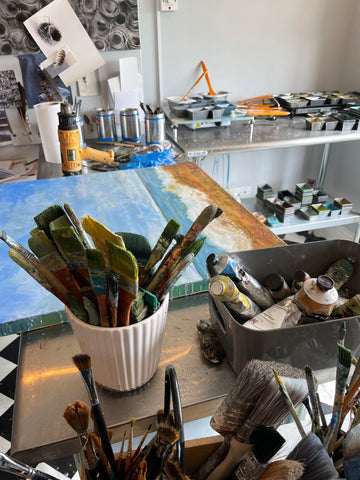
The heated palettes provide softened creamy molten colour in tins waiting to be saturated with pigment or thinned and translucent. Mixing colours and different quantities of wax opens up endless possibilities for saturation and washes. The range of hand tools employed is vast from fine dental steel implements to large chunky brushes made of wood and natural animal hair.
Wax and pigments are fused with heat, which dries quickly, capturing brush strokes, drips and textures. Encaustic art is an all consuming very physical practice. One is seduced by the process of not just applying paint with a brush, palette knife or hands but also the harnessing of heat to energise materials and move the liquids around. The fluidity of the process allows the materials to mix and metamorphose.

Encaustic Painting - an Ancient Art
There are examples of this ancient art, practiced by the Greeks and the Egyptians, from 2000 years ago. The British Museum has examples of portraits from 100-300 AD. The Fayum encaustic pictures are still vibrant, providing an amazing historical testament to the longevity of the medium. Painted as part of the mummy casing, the deceased’s portrait was depicted fully dressed with a background around the head. A visit to see these in the flesh is at the top of my list for my next research trip to London.


