
New Series - Breathing Space
The gaps engineer breathing spaces in the painting that encourage an additional dialogue within and around the work. Whilst the three-dimensional planes of the plates engender an alternative viewpoint, the ceramic forms deliver shadows and highlights creating intriguing faceted elements that change with the light. Embracing the Japanese concept of Ma, where each negative space is as valuable as the positive, each void adds meaning, balance and rhythm to the painting.

The concept for the painting is developed and then the lengthy process of sourcing the exact combination of antique ceramics to build the platescape is commenced. It is not only the shape and size that matters, but also the clay, the age, wear and marks. Decoration, colour and subject are also key, as all contribute to the success of the composition. Each element is well researched before the final painting is planned.

The language of the old cloth is harnessed to enhance the pictorial narrative. By using the characteristics of antique material as a canvas, it becomes a contributing value to the work. The ancient hand woven cloth, with its attractive vagaries of the hand made process, is extolled in each celebration of the selvedge, hem, join or seam. Antique embroidery, cutwork and lace are employed in some paintings, where this extra attribute is appropriate and prized.

The pattern on the original plates is fundamental to the concept behind the work. Whether traditional bucolic scenes in Toile de Jouy style or massed florals, the aim is to guide the subject matter and enhance the final composition. From a distance the overall effect is harmonious, but on close inspection the miniature details are revealed. The manipulation of scale adds further depth to the engagement.


Creating art with a multi-layered ambition has always been a preoccupation. In 'Breathing Space' I have found a challenging format that embraces my passion for both painting and form. The platescapes add a 3D perspective that bridges the gap between painting and sculpture.
Blue Vase
An original still life oil painting on a collection of 7 pieces of antique china. The painting features preserved eucalyptus leaves and dried craspedia flowers in a blue vase with an orange and lemon, becomes disjointed and yet enhanced, as the narrative is rewritten in the breathing spaces.

Materials:
Ceramics
7 pieces of antique crockery
- Pair of antique Booths tureen plates in the Princess pattern. Semi porcelain Rd. 183173.
- Victorian tureen plate no.186329
- Antique tureen semi-porcelain plate no.345664
- Booths 1906 moon side plate in Lowestoft Border design
- 1886 saucer Pre Shelley Old Foley Rd. no. 49676 (3645)
- Victorian Childs doll house plate with willow pattern
Cloth
Old linen tea cloth - hem used to suggest a frame
Paints
Michael Harding UK: professional hand made, ethical oil paints.
Hanging
Each part of the painting is supplied with a plate hanger.
A life size plan, showing the exact location for hanging each composite piece, is provided.

Dimensions of composite painting: height 63cm x width 56cm

Fishing
An original oil painting on a collection of 4 pieces of vintage china. The painting features freshwater fish swimming in a golden pool of light where the breathing spaces add another layer of disjuncture. The narrative is enhanced with the bucolic scenes of fishermen on the vintage plates.
This artwork was launched at The Gallery, 23 Lees Yard, Holt NR25 6HS in the Fired Earth exhibition 31st October – 10th November 2026.

Materials:
Ceramics
4 pieces of vintage crockery
- 1930-40 Royal Doulton 'Norfolk' dinner plate
- 1950-60 Crown Ducal 'Bridge Scenes' dinner plate
- Vintage Alfred Meakin 'Queens Castle' oval serving platter
- Vintage dinner plate
Cloth
1800s French peasant flax cloth - grown, spun and hand woven by rural folk - hand stitched hem used to suggest a frame
Paints
Michael Harding UK: professional hand made, ethical oil paints.

Hanging
Each part of the painting is supplied with a plate hanger. A life size plan, showing the exact location for hanging each composite piece, is provided.

Dimensions of composite painting: height 71cm x width 61cm
Failing and Learning

One of the delights of painting with oils is the meandering journey that lets you experiment and fail. The small wins are precious and deliver joy. I have always had a buzz from learning, so painting feeds that in a quiet, understated way that keeps me curious. It's not just the activity that is so absorbing, it transports you to another world, it is also the thinking. The thinking requires not just a collective memory bank of skills, but an enquiring mind and willingness to take risks - what if I...? It is a constant problem solving exercise and the search for resolutions can be taxing. Even after all these years, there are conversations in my head about risk taking and rising to the challenge, underpinned by the "You CAN do this" mantra.


And what happens when the result is not even satisfactory? The task of 'making it right' can form a loop that becomes a bottomless rabbit hole of intense pushing. One is often unaware that this is taking over. Step away, give both time and distance to the issue. Then refreshed, this could be hours or weeks later, judge it anew and matters have often shifted. Now that troublesome area is actually quite good, whilst the bit that you were pleased with before is alarmingly wrong!


With oils, time is your friend. I have painted with all the different media over the years - experimenting, playing and analysing each material and technique for its foibles. Each media has its own attractions and limits and finding one that connects is key to building a deep relationship. I first tried oil painting at an evening class I attended aged 19 - I timidly brushed the paint with little strokes from a little brush. At art college, oils were never discussed, whilst the more instantaneous acrylic paint was favoured. I returned to oils years later as my fascination with building texture and form on a 2D plane became a focus. A palette knife and thick oil paint now provide endless possibilities and happiness. But with oils, time is also not your friend if you are impatient. Impasto painting demands lengthy drying times which can be frustrating when the next layer of engagement is beckoning. I have learnt many times that muddiness awaits if you revisit a wet painting too soon. All that squishiness is delicious, but be aware of the trap of impatience.
 .
.  .
.
Letting go is one of the hardest things. A painting that just isn't working, but has delightful elements is a conundrum. Should I continue or just start again? When to push through and when to move on, is still a dilemma. It is at this point I ask myself "What is the value of continuing?" Obviously, the answer should inform the decision, but often there is a niggle remaining. Is that the vagaries of the creative brain or something else? Ultimately, deciding is a choice only you can make. I have found that what one may consider helpful opinions from others, usually are most unhelpful. Yes others views have value, but its the artist that must exercise omnipotence over their work. After all, a painting is an artist's statement of self expression.


Working to Commission
It is always a pleasure when a client decides to commission an artwork. Some clients have a very clear idea of their requirements, whilst others need assistance. I have spent over 30 years of working to commission and enjoy deciphering what is really desired. This blog post is to simply explain the process, so you know what to expect.

Here's a list of things to consider when considering commissioning an artwork:
-
Budget - it is helpful to have some idea of how much you want to spend at the start. Realistically, this can change as the commission is discussed and options are taken. Don't be concerned about raising financial issues - it's a discussion, not a contract at this stage.
-
Schedule - is there a specific date that you need the artwork for eg. a birthday/anniversary etc. or is just as soon as possible?
-
Subject matter and style of execution.
-
Materials
-
Size - if you're not sure what size would work best, then experiment with paper cut to size.
-
Location - where in a room is the best place to showcase the artwork?
-
Light sources - is there natural light, is the work likely to fade, do I need specialist lighting etc?
After all the points above have been discussed - a plan is agreed.
It is important to have a simple agreement drawn up to make the process straightforward and transparent. Below is a summary of the process.
The basic commissioning process
1. We agree a brief, cost and timeline.
2. A non-returnable deposit is required to schedule the work - usually 50%.
3. The materials are ordered.
4. The painting/drawing is researched and executed.
5. The finished work is shown to you for feedback. Any alterations are made. The painting/drawing/plate or photo of the revised final picture is shown to you.
6. The work is then framed if relevant.
7. On completion, we will agree a convenient collection date and location.
8. The balance of the fee is required at completion.

Commissions vary widely in size and content - a recent one was quite specific, so I was delighted when the client emailed this to me,
"It's beautiful. I love the light on the horizon and the movement in the waves - you have captured exactly what I wanted but was having difficulty articulating."

Seascape - 'The Best of Days' encaustic painting for client Dr. W.
If you would like to discuss commissioning a piece of art,
then please get in touch.
Coming Home
Being Home Collection
A Collection of Original Oil Paintings by Jac Scott.

An antidote to fast living.
The domestic space has long held a fascination with many artists. Whatever the medium, to transpose the enigmatic and the mundane of home, is an enduring focus. Often drawing our attention to the small and overlooked elements, these still life works form narratives on our way of living.

Here Scott is preoccupied with the celebration of the joy of home comforts and the reflection of her feelings that these simple objects bring. By painting atmospheric vignettes, she focusses our gaze on a few items that capture the essence of the subject.

Her own country home forms the canvas for this unique collection with her love of old crockery, antique books and flowers emanating throughout the paintings. The casual, contemporary format of the compositions, the painterly style of the brushwork and the saturated colour palette, create an inviting window into the artist's world.

"I want to create pictures that are colour baths to wallow in and to soak up the warmth. The cosy style should feel like a wall-based hug".

"I want to enjoy wobbly towers of pretty vintage teacups, rows of mis-matched tea plates, (maybe a butterfly has landed on one?) clusters of quirky old tea and coffee pots, worn squashy sofas, and stacks of well-read books."

The Home Collection is an evolving body of work, so expect nuances and surprises along the way.

Passion on a Plate - original fine art on vintage plates
Plated Collection

I have had a passion for antique white plates for many years and collect reticulated ones - they make a lovely display on the wall with unusual shadows through the holes. My collection is not extensive as good ones are hard to find and those with chips or cracks are not of interest. Displaying them in groups makes a strong statement. So it was this love of old white plates that ignited the idea of collecting interesting vintage white plates. They have to speak to me in some way. Painting original still lifes on them hopefully makes them covetable again.
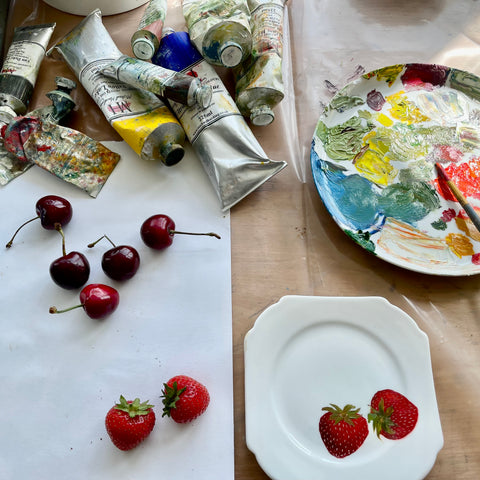
It's fun to do and I enjoy the immediacy of it. My drawings and paintings take so long to do, whilst the plates are relatively quick - although of course the oil paints still take weeks to dry.

I confess I only paint subjects that interest me and those that seem to 'sit happily on a plate'. That expression is hard to define but see if you agree. Beautiful vegetables and fruits, some picked from my own garden, glistening fish and antique cutlery are first to be captured. These simple still lifes look great on their own or even better in a group. Building a plate-scape is simple as I sell them ready to hang with a brass plated hanger (with protective ends) and a wall fixing, so super quick and easy to attach to your wall. Alternatively, you could place the plate on a special stand. It's fine art on a plate only - don't ever use them for eating or put them in your dishwasher!


Artists throughout history have been drawn to designing plates - strange but true. Even Picasso in the 1940s embraced the art form, creating unique pieces as well a limited edition designs with a local pottery. In the 1970s Julian Schnabel and Judy Chicago famously harnessed the power of the humble plate to send their eloquent messages. But does this question the traditional hierarchy of the art world - is it subverted? How delicious. Does the fine art element diminish - is it of less value because its on a plate - does the association of domesticity devalue it? What do you think?

To find out more about the history of painting on plates click on this link
https://www.artspace.com/magazine/art_101/art_market/artist_designed_tableware-51836
Bewitched by Colour - Painting in Colour
I have spent my life in black and white studying greys. My obsession with colour meant that I needed to extricate it from my career palette in order to draw. To draw in detail, to observe, to edit, to mark and mark again. The employment of colour would confuse my goal, so it was purposefully ignored. When I did introduce colour into my work it was restrained, limited and controlled. Only one colour at a time. Its role was functional - to pop!
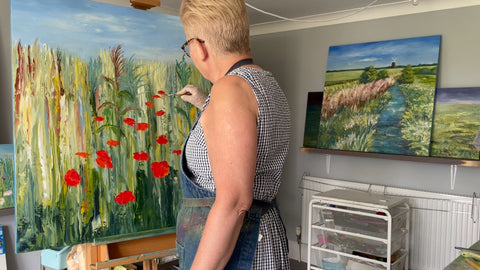
Creativity is energising. I'm having fun experimenting with relationships and exploiting the dynamics of colours - always learning and enriching my portfolio. This excitement is nurturing - my curiosity sparked - enquiries into 'what if?'. I'm not interested in slumber, but rather being awakened inside to discover new and more. Experimentation means that mistakes are plenty and have to be worked through - I expect to go wrong sometimes. It is calling on my depth of experience to find solutions and execute them. The mastery of techniques and materials is a lesson for life, so curiosity is helpful and perseverance too. Getting older helps as one's inner voice reminds one that 'you can do this - keep going'.

Now that I am indulging in paint, I am wallowing in colour - luxuriating in all the millions of nuances and hues. The joy of creating thick, multi-layered colours, embracing impasto painting with relish, has engineered a sense of freedom unknown before. Yes, my paintings are experiences that envelop the viewer - emotional responses laced with energy. Just as with my drawings, the more you look the more you see, but with paint it is very much a physical event. The quality of the paint assists in the translation of different narratives. The viewing distance alters the experience significantly. The paintings are invitingly tactile with textured surfaces - multiple layers of paint on paint, colour on colour. The depth is vital, for it resonates the emotion that I am layering and transposing, from vision to canvas.

Colour can be bewitching. It speaks to us and entices our personal stories to relate to it. Everyone has a favourite colour, that is a colour that resonates with them, shaped by their life and memories. Whilst nurturing this relationship we can enhance our own perception of what we need around us to fuel our moods. Yellow is a prime example of the power of colour. Depending on your innate response to this hue, its impact in its most vibrant form can be seismic, with the potential to lift moods and bring joy. Whilst its darkest tone can be miserable and mysterious. But this is not a rule - colour is amorphous. Ones reaction is guided by the viewer's inner world. So colour is personal and therefore the emotional intelligence behind each painting plays with the power of colour.


My dark paintings are moody with chiaroscuro being a favoured technique to evoke the ever changing balance of the elements. The aim is for them to be dynamically atmospheric by transposing an emotion in response to stormy skies or the depth of midnight. So the energy of the palette is not focussed on being menacing or gloomy, even though some interrupt that message, but rather of embracing the celebration of the interplay of light and dark.

In contrast, the more sunny paintings shout out the sheer joy of being alive in such wonderful places. They are statements luxuriating in colour.

NEW Collection - Fields of Wonder
Fields of Wonder

This new collection was created as an exhibition to be launched as part of Holt's Arts Festival 2023.

BELOW: Inspiration - the wild poppy meadow discovered at Walsingham

BELOW: Inspiration - the wild meadow discovered at Fulmodeston

BELOW: Inspiration - the wild meadow discovered at Swanton Novers

BELOW: Inspiration - the wild meadow discovered at Fulmodeston

BELOW: Inspiration - the meadow discovered at Fakenham

Focus
Scott's aim is to create a painting that is almost a joyful meditation on a piece of land. For this she researches in the field, making preparatory studies, wordscapes and taking photographs. A low perspective emerges from the submersion, creating purposefully limited sight lines and a narrow focus. This concentration enhances the caress of the plants and their sway in the breeze.
Morning
by Charles Tennyson
It is the fairest sight in Nature’s realms,
To see on summer morning, dewy-sweet,
That very type of freshness, the green wheat,
Surging thro’ shadows of the hedgerow elms;
How the eye revels in the many shapes
And colours which the risen day restores!
How the wind blows the poppy’s scarlet capes
About his urn ! and how the lark upsoars!
Not like the timid corn- craik scudding fast
From his own voice, he with him takes his song
Heavenward, then, striking sideways, shoots along,
Happy as sailor boy that, from the mast,
Runs out upon the yard -arm , till at last
He sinks into his nest, those clover tufts among.
BELOW: Inspiration - the wild meadow discovered at Walsingham

Commissioning a Painting
It is always a pleasure when a client decides to commission a painting. I have spent over 30 years of working to commission and enjoy deciphering what is really desired. The subject is of course very important and the style of execution too. Knowing the location in a room always helps, so we can discuss the light and size of the potential work.
BELOW: The Best of Days painting commission for Ms. W
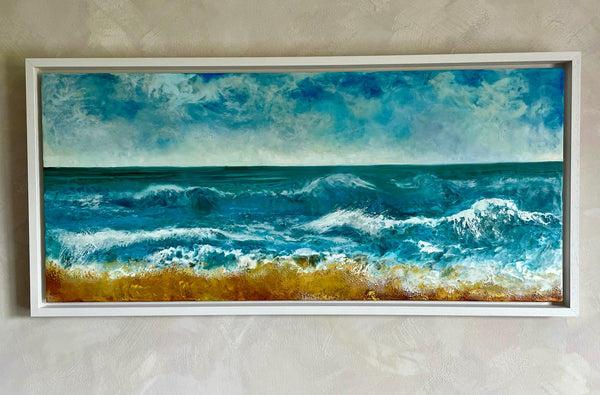
Commissions vary widely in size and content - a recent one was quite specific, so I was delighted when the client emailed this to me,
"It's beautiful. I love the light on the horizon and the movement in the waves - you have captured exactly what I wanted but was having difficulty articulating."
It is important to have a simple agreement drawn up to make the process straightforward and transparent.
The basic commissioning process
1. We agree a brief, cost and timeline.
2. A non-returnable deposit is required to schedule the work.
3. The canvas and materials are ordered.
4. The painting is researched and executed.
5. The finished work is shown to you for feedback BEFORE it is framed. Any alterations are made. The painting or photo of the revised final picture is shown to you.
6. The picture is then framed. On completion you will be notified and asked to collect it from the gallery and to settle the balance.
BELOW: Rain Dance 2 commission for Mr & Mrs D.
If you would like to discuss commissioning a piece of art
then please get in touch.
The Agony and the Ecstasy of Oil Painting
The Agony and the Ecstasy of Oil Painting
Jac Scott
A friend recently asked me if I ever get bored painting the coast? My reply came easily - the coastline is always changing, in every second it metamorphoses. Aiming and failing to capture that energy or tranquility is so bewitching that I'll never master it or tire of trying to do so.
Painting the Norfolk Coast
The elements of sky, sea and shore dance and shift continually. It's the movement and the interplay of the elements that is beguiling. Standing before the ocean and absorbing the sights, sounds and smells to carry home to the studio, is both humbling and invigorating. I find making short videos of the panorama can help the journey, but nothing matches the initial excitement of the moment. Doing quick sketches and colour studies are an intrinsic part of the process. The large scale I prefer to work at demands a big set up, so it is highly problematic working on location.

Painting Simple Compositions with Complicated Layers
The compositions are rudimentary - I really like that. Capturing the viewer's eye without an obvious focal point demands other elements of interest and nuance. Colour and texture are key. The process is dynamic. It makes it even more challenging to carry that simplicity and create a picture that has depth, movement and spirit. The techniques I use embraces this - nurturing the notion of shifting layers. Visualising and then building the layers is a multi-pronged operation where understanding three-dimensions is critical. One is building from the back of the painting and seeing forward - therefore planning is key.
Each element is faceted like colours - their translucency or opaqueness is important to exploit the medium's variables. Subject matter such as skies and seas envelop the multi-layered approach and react well to embracing different strengths of coloured layers.

Emotional Painting
Yes the paintings are emotional expressions, not copies of anything stagnant. I want them to be transitional - to carry one to another place - to form a ticket to ride. Painting requires concentration and control, and yet however much you master the materials, there is always an element of serendipity that I love. That unexpected joy or horror that emerges when you think it's safe. This duality of agony and ecstasy whilst painting becomes a canvas full of problems to solve and I am elated if I manage to master them. Such an absorbing activity is demanding both mentally and physically, especially when I work on the big panels. The width and longevity of my art practice definitely informs my painting. It has nuances towards sculpture - planning in three dimensions, layering and cutting back.

Moving to North Norfolk
I grew up by the sea and regularly spent hours watching the waves, never thinking that those early memories would guide my focus now. When we moved from Bournemouth to the Lake District I was still needing to regularly visit the coast and share the big skies away from the brooding mountains. Moving to North Norfolk was liberating - it is a special place: a sanctuary and a stimulus for my spirit and my art practice. We had visited for seven years before we decided to move permanently - it was the best thing we ever did.


Materials of My Mother Tongue - Painting with Oil & Wax
Materials of My Mother Tongue - Painting with Oil & Wax
Simple imagery with a strong graphic quality draws me in. Rhythmic bands of interest broken with a vertical focal point is visual poetry to my eyes. The striping delineates and dissects the panorama. Whether wide or sinuous - it’s the dynamic of the sections that is exciting. It is the balance and harmony versus the abrasion of colours and textures that is engaging. I see the challenge as an artist, is how to make such basic inspiration intriguing - to translate the joy into something tangible through media. A lifetime of layering different materials to build and excavate has led to multiple approaches. The current fascination with pigment and wax has evolved over many years of experimenting to source a painting medium that embraced all that I needed to execute the energies within. In these natural materials I have found a voice that speaks my mother tongue.


Artist's Research
I am seeking to create on the canvas, an almost reincarnation of a fleeting moment that requires an enveloping of the elements at the site. Whether a tranquil haven or a dramatic storm the immersion is aided with research: sketches, colour studies and photographic details. But the process of absorption, reflection and creation is so full of energy and dynamic interactions, between myself and the medium, that I find the best way to record my inspiration is by filming the subject matter. Just by taking video clips, the essence of a place is better transported to my studio, than through stills that freeze the energy I wish to evoke. Whilst, wishing to paint on site seems attractive, my chosen medium is very limited, as intense heat and power are critical.


Artist's Materials & Process
In the studio it is a juggling act of controlling hot and cold - an alchemy of materials and old techniques mixed with new technologies. The materials are natural: pigments and bees wax, mixed with dammar resin to set the strokes. These are brushed, knifed, poured and rubbed onto specially sealed wooden boards, then layered and fused, layered and fused and repeated. The rhythm is broken by incising, texturising and sgraffito. The process is reactive with a strong element of serendipity tempered by intuition. I embrace the challenge and realise it will take more than a lifetime to hone any skill set.

Encaustic Painting
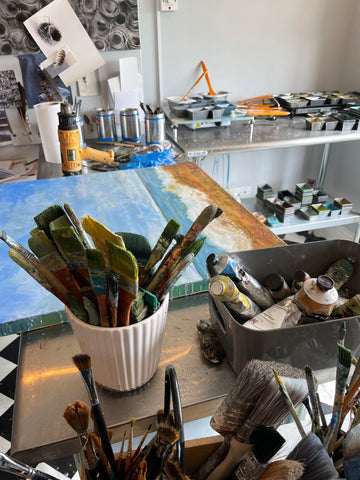
The heated palettes provide softened creamy molten colour in tins waiting to be saturated with pigment or thinned and translucent. Mixing colours and different quantities of wax opens up endless possibilities for saturation and washes. The range of hand tools employed is vast from fine dental steel implements to large chunky brushes made of wood and natural animal hair.
Wax and pigments are fused with heat, which dries quickly, capturing brush strokes, drips and textures. Encaustic art is an all consuming very physical practice. One is seduced by the process of not just applying paint with a brush, palette knife or hands but also the harnessing of heat to energise materials and move the liquids around. The fluidity of the process allows the materials to mix and metamorphose.

Encaustic Painting - an Ancient Art
There are examples of this ancient art, practiced by the Greeks and the Egyptians, from 2000 years ago. The British Museum has examples of portraits from 100-300 AD. The Fayum encaustic pictures are still vibrant, providing an amazing historical testament to the longevity of the medium. Painted as part of the mummy casing, the deceased’s portrait was depicted fully dressed with a background around the head. A visit to see these in the flesh is at the top of my list for my next research trip to London.


Capturing Trees in Ink

Drawing Trees
Drawing Trees in Winter
Winter is the best time of year to research new trees to draw. The skeletal forms are mesmerising, whilst often challenging, due to the difficulty in extracting their form from the background. A specimen tree on the horizon with the sun glinting through makes an ideal subject to draw as a silhouette, but nature doesn’t often present this scene. Deciding on the composition usually takes place on site and involves preliminary sketching and the taking of numerous photographs. The images are taken from a distance to set the scene and then closeups for the trunk and branch configuration, plus bark details. Revisiting the location many times is usually necessary to glean particular information - rarely can one study contain everything required to transpose a true picture. The work is intense and detailed and executed in the studio.

The Drawing Technique
The process commences with serious editing, coupled with decisions about which trees to draw in silhouette and those to detail. The drawing technique employs a discipline of restricting the building of the form just to making monotone marks, rather than the employment of colour or shading, leading to a focussed study that is very time consuming to create. The mass of marks, varying in shape, strength and size, is repeated, then repeated. The approach to drawing is in a similar vein to that of the traditional building process of creating a sculpture with the rhythm of multiple marks both building and extracting until a form evolves from the ground. The technique is paradoxically quick in hand movement yet slow to evolve.

Artist's Research
On a research visit to Felbrigg recently, a pair of old oaks at the front of the Hall stood out as worthy specimens. There was also a wonderful very old chestnut tree asking to have its character recorded before the next storm took another limb. These trees will studied at length then drawn for the Arboretum Collection where they will accompany the sycamore and beech at Felbrigg.

General Information
Jac Scott is multi-award winning artist and a member of the Royal Society of Sculptors. She draws and paints what she loves: trees, wildlife, the countryside and seascapes that she discovers in Norfolk. The detailed drawings are shared as fine art giclée prints in limited and open editions. The artist retains the originals. The prints are made by specialist printers who are members of the Fine Art Trade Guild. A giclée print is a term used to describe a fine art digital printing process combining pigment based inks with high quality archival quality paper to achieve an inkjet print of superior archival quality, light fastness and stability.

Limited Editions of 50 - Special Collections
Signed, catalogued, limited edition of 50, fine art prints are available framed or unframed.
The drawings are giclée printed on Hahnemuhle Photo Rag 310gsm pH neutral paper made from 100% cellulose.
Open Edition Fine Art Prints

 .
.  .
. 
All open edition prints are printed on Redcliffe Watercolour paper and are available in different sizes and colours - framed or unframed.

Red Lace - a story of a painting

A simple story of a painting.
Sometimes it’s the simple pleasures of living in this beautiful county that bring a lingering smile, such as looking forward to the casual, yet dynamic blooming of the wild poppies in June. The impact can be just a single lost flower or the invasion of a whole field swathed in red.

But usually it’s a graceful lacing of the field edges - red heads of delicate crepe paper petals bobbing in the breeze.

This June on a winding lane from Edgefield, near Holt, there was a particularly wonderful field of poppies - so inspiring I had to paint the view.

